
Collaborative development / EXCHANGE & EVENTS
Taiwan Defense Tech Hackathon 2026
A three-day program of collaborative development, mentor exchange, and Demo Day connecting engineering communities in Taiwan and Europe to explore applications of unmanned systems and societal resilience.
- Event date
- 2026.10.02 — 2026.10.04Event recap
- Event location
- Tsung Cho Chang Hall, Department of Mechanical Engineering, NTU
- Center’s role
- Co-organized with the European Defense Tech Hub and the Institute for National Defense and Security Research; supported the venue, registration, and on-site administration, and facilitated team development and interdisciplinary exchange.
- Organizers and partners
- Co-organized by the European Defense Tech Hub, the Unmanned Vehicles Research and Development Center, NTU, and the Institute for National Defense and Security Research
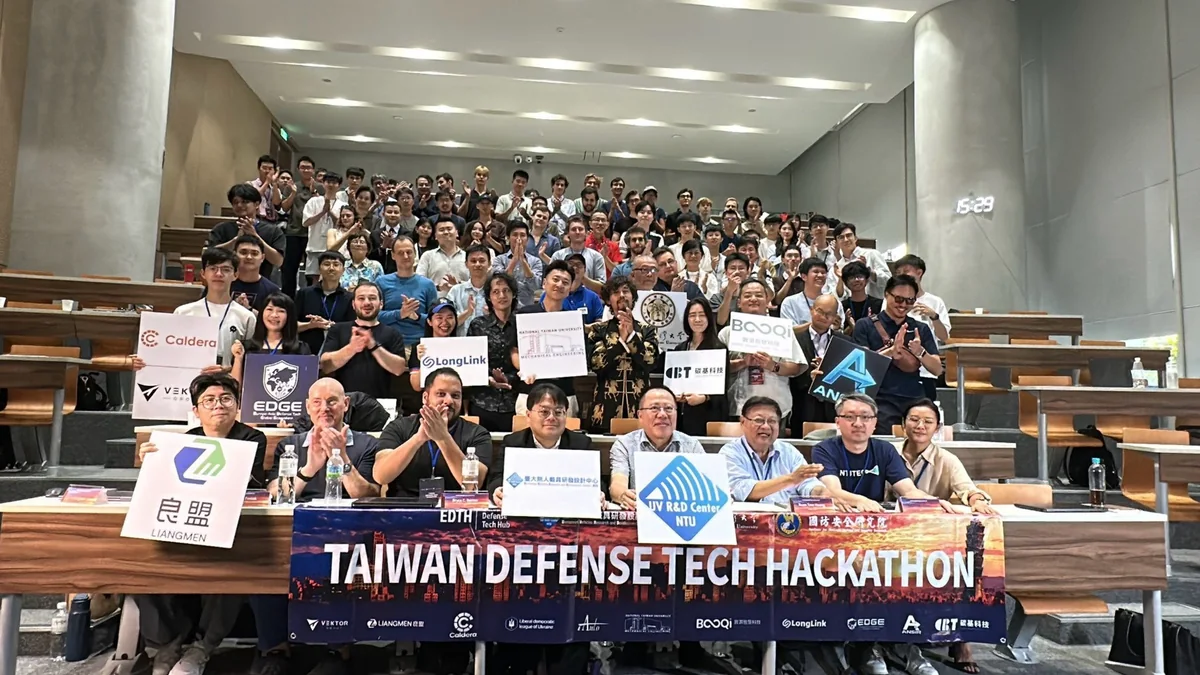
Engineering Collaboration for Security and Resilience
The Taiwan Defense Tech Hackathon 2026 was held from October 2 to 4, 2026, at Tsung Cho Chang Hall, National Taiwan University. It was co-organized by the European Defense Tech Hub (EDTH), the Unmanned Vehicles Research and Development Center, NTU, and the Institute for National Defense and Security Research. The program combined topic presentations, workshops, team development, mentor discussions, and project presentations, giving participating teams a setting to turn security needs into demonstrable technical concepts.
Interdisciplinary Teams Explore a Range of Technical Challenges
The event platform listed 15 proposing teams, with topics spanning offline collaboration, navigation in GNSS-denied environments, multi-vehicle task allocation, drone detection, image fusion, maritime security, acoustic sensing, edge AI, and commercial drone risk assessment. Teams could respond to challenge topics or develop their own directions, and exchange ideas with mentors from different professional backgrounds.
A Three-Day Program from Kickoff to Project Presentations
The first day featured an opening, keynote presentations, a competition briefing, and workshops, followed by the start of team development. The second day focused on hands-on work and mentor discussions. On the third day, teams tested their presentations, presented their work, received judging feedback, and joined the closing session. A workshop on changing forms of warfare and building the right things invited participants to consider prototype design in light of real-world scenarios.
Announcing Team Proposals and Awards
Among the results published on the platform, MARLIN placed first with a proposal focused on undersea cable security around Taiwan. UAV/USV Threat-Reporter placed second, proposing a mobile application for reporting suspicious vehicles such as drones and unmanned vessels. DeVoSim placed third, focusing on testing, automation, and simulation across software, hardware, and hybrid environments. MEERKAT SENTRY received an Honorable Mention for a concept combining rooftop monitoring with drone detection. These awards reflect the proposals reported by the platform; each concept may be developed further through subsequent testing and validation.
Center Support for the Venue and Event Operations
The Unmanned Vehicles Research and Development Center, NTU, co-organized the event and supported venue arrangements, registration, and on-site administration, enabling team collaboration and the exchange of project work. Together with EDTH, the Institute for National Defense and Security Research, and other partners, the Center helped facilitate interdisciplinary dialogue connecting engineering capabilities with security needs and opening a starting point for further exchange and engagement among talent.
Event agenda
View Full agenda17 items
- 10/2 12:00–14:00
Doors Open, Registration, and Networking
Participants checked in and networked.
- 10/2 14:00–15:00
Organizer Welcome and Keynote Presentations
Opening remarks and keynote presentations.
- 10/2 15:00–15:30
Competition and Venue Briefing
An overview of the event rules and venue arrangements.
- 10/2 15:30–16:00
Networking Break
A tea break and informal networking.
- 10/2 16:00–16:45
Workshop: The Changing Face of War – Build the Right Things
A workshop on changing forms of warfare and developing technology that meets real needs.
- 10/2 16:45–17:30
Mentor and Challenge Topic Introductions
Introduction of mentors and the event challenge topics.
- 10/2 17:30–18:00
Development Kickoff and Move to Workrooms
Teams began development and moved to their workspaces.
- 10/2 18:00–23:30
Team Development
Teams worked on developing their proposals.
- 10/3 08:30–09:00
Doors Open
Participants entered the venue.
- 10/3 09:00–23:30
Team Development
Teams continued building and preparing their presentations.
- 10/4 08:30–09:00
Doors Open
Participants entered the venue.
- 10/4 09:00–10:30
Final Development
Teams completed their proposals and presentation preparations.
- 10/4 10:30–11:30
Presentation Submission and Testing
Teams submitted presentations and tested their demonstrations.
- 10/4 11:30–13:00
Lunch and End of Development
Lunch break and conclusion of the development period.
- 10/4 13:00–15:00
Team Project Presentations
Teams presented their proposals and received feedback from the judges.
- 10/4 15:00–15:30
Results Announcement and Closing Session
Platform results were announced, followed by the closing session.
- 10/4 15:30–17:00
Networking
Participants networked and exchanged views.
Further reading
Official event websiteCONNECT WITH US
Industry–academia collaboration
and technical exchange
Connect academic expertise with industry requirements to develop collaboration in unmanned vehicle research, systems integration, and professional education.